4x4 Parity: OLL and PLL
You’ve built the centres, paired the edges and solved most of your 4x4 like a 3x3, and then you find one edge flipped, or two edges swapped. That can’t happen on a 3x3. It is called parity, and each kind has one algorithm that fixes it.
OLL parity: one edge flipped
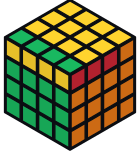
You see this while making the yellow cross: an odd number of yellow edges are facing up (1 or 3). Hold the cube with the flipped edge at the front of the top, and do:
Rw U2 x Rw U2 Rw U2 Rw' U2 Lw U2 Rw' U2 Rw U2 Rw' U2 Rw'
OLL parity fix: the front top edge flips over.
Rw means the right two layers and Lw the left two. The x in the middle turns the whole cube forward (like R). It is long, but it repeats “Rw U2” a lot, which makes it easier to remember. It also moves a few other top-layer pieces, which doesn’t matter because you haven’t solved the last layer yet. Afterwards, carry on with the yellow cross as normal.
PLL parity: two edges swapped
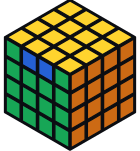
You see this at the very end: two opposite edges on top are swapped, or your last-layer case doesn’t look like any 3x3 case (for example two corners seem swapped with everything else solved). Hold the two swapped edges at the front and back of the top, and do:
2R2 U2 2R2 Uw2 2R2 Uw2 U2
PLL parity fix: swaps the front and back top edges.
Here 2R2 means turn only the second layer from the right, half a turn (some guides write r2). Uw2 turns the top two layers half a turn, and the final U2 lines the top corners up again. If two adjacent edges are swapped instead, use a U-turn or a PLL first so that the swapped pair ends up opposite each other.
Why does parity happen?
On a 3x3, every quarter turn swaps corners and edges in step, so a single swap of two edges is impossible (see cube maths). On a 4x4, turning an inner layer moves edge wings and centres but no corners. The centres look the same whatever order their identical pieces are in, so the cube can quietly end up with an odd swap of wings hidden in the centres. When you pair edges and solve the outer layers, it shows up as a flipped edge (OLL parity) or a swap (PLL parity). Each happens in about half of all solves.
The 4x4 solver spots parity for you and adds the fix as a separate step, so you can see exactly when it is needed.
Questions people ask
What is 4x4 parity?
A position that can’t happen on a 3x3: one edge flipped (OLL parity) or two edges swapped (PLL parity). It comes from the inner-layer turns.
What is the OLL parity algorithm?
Rw U2 x Rw U2 Rw U2 Rw' U2 Lw U2 Rw' U2 Rw U2 Rw' U2 Rw', with the flipped edge at the front of the top.
What is the PLL parity algorithm?
2R2 U2 2R2 Uw2 2R2 Uw2 U2, with the two swapped edges at the front and back of the top.
Can I avoid parity?
Not by solving carefully: it depends on the scramble. Advanced solvers spot it early and fix it while pairing edges.