This is the advanced Connect 4 strategy that strong players and computers use. It explains why some threats win and others never get used.
Number the rows
Count the rows from the bottom: row 1 is the bottom and row 6 is the top. Rows 1, 3 and 5 are odd; rows 2, 4 and 6 are even.
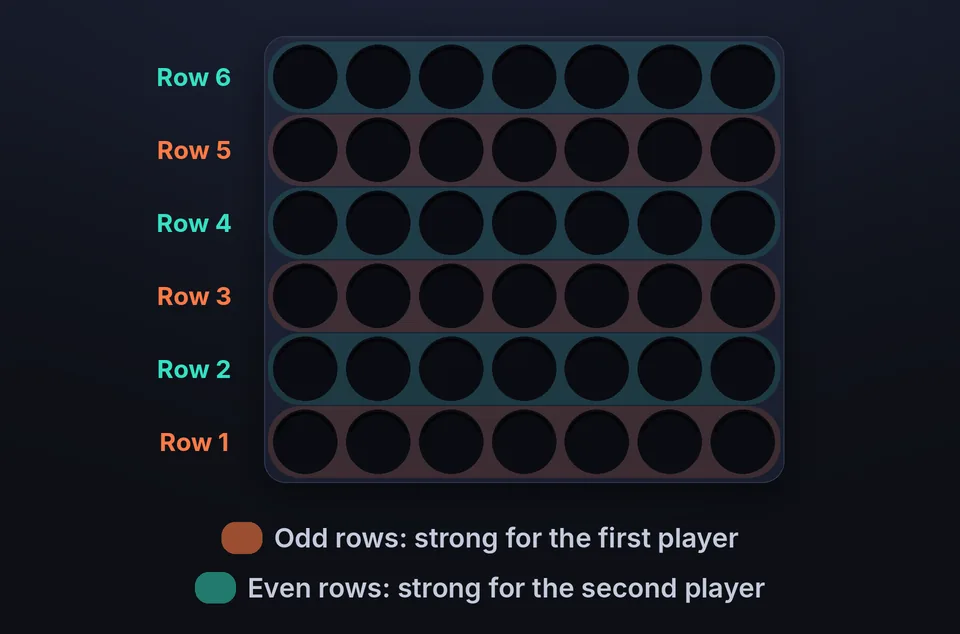
Why row numbers matter
Near the end of a game, players often have to fill up columns one disc at a time. When the board fills evenly, the first player tends to fill the odd-row spaces and the second player the even-row spaces. So:
- If you went first, threats on odd rows (3 and 5) are strong. Your opponent will eventually be forced to play below them, giving you the win.
- If you went second, threats on even rows (2, 4 and 6) are strong for the same reason.
A threat on the “wrong” row type for you is far less likely to be used.
Zugzwang
Zugzwang is a German chess word for a position where every move makes things worse. In Four in a Row, it means your opponent has to play a disc, and every column they can choose lets you win. Good odd and even threats create zugzwang.
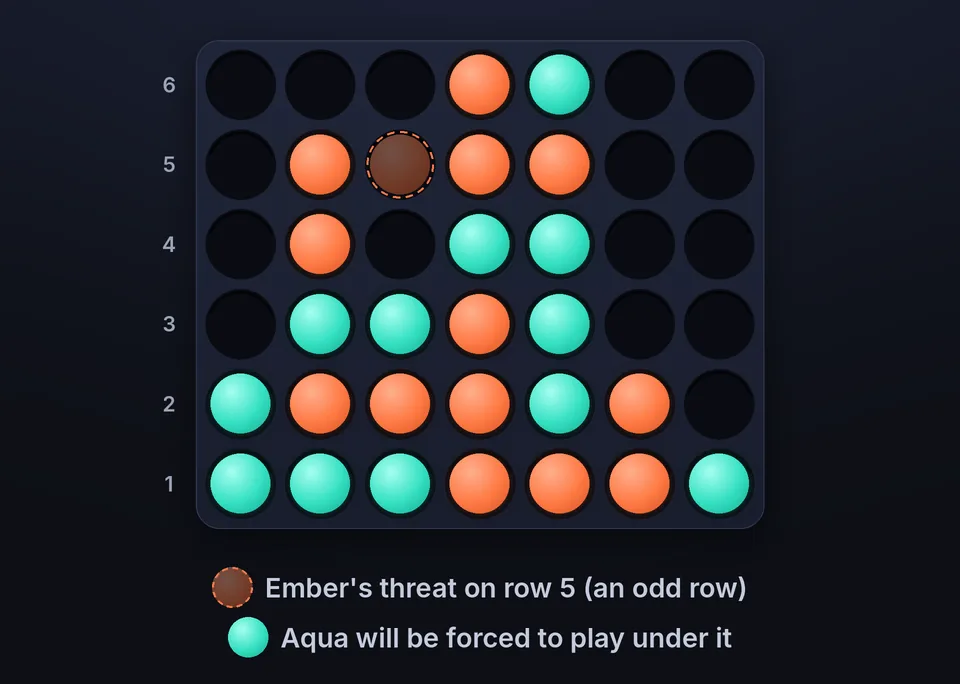
Putting it into practice
- Note whether you went first or second.
- When building threats, prefer rows of your type.
- Don’t waste moves on threats your opponent will never have to give you.
- Late in the game, count the empty spaces column by column to see who will be forced to play where.
Test yourself against the Hard computer.
Keep reading
- How to Beat the Computer at Four in a Row
- How the Four in a Row AI Works
- Seven Common Four in a Row Mistakes
More in Four in a Row Strategy: How to Win at Four in a Row · Best Opening Moves in Four in a Row · Four in a Row Cheats and Tricks · Seven Common Four in a Row Mistakes · How to Beat the Computer at Four in a Row · Odd and Even Threats in Four in a Row
Back to Four in a Row Strategy · Play the game now