How to solve a Rubik’s cube: the beginner’s method
Anyone can learn to solve a 3x3 cube. The beginner’s method breaks it into seven small steps, solving the cube layer by layer from the bottom up. You only need seven short move patterns, and most people get their first solve within a few hours of practice.
Before you start
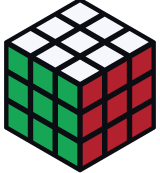
- Centres don’t move. The middle sticker of each face stays put compared with the others. White is always opposite yellow, green opposite blue, red opposite orange. So the centre tells you what colour each face will be.
- There are three kinds of piece: 6 centres (one colour), 12 edges (two colours) and 8 corners (three colours). You solve pieces, not stickers.
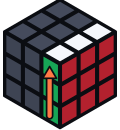
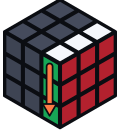
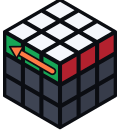
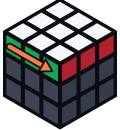
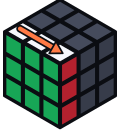
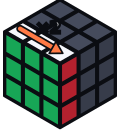
- Learn the letters. Moves are written as letters: R means turn the right face clockwise, U’ means turn the top anticlockwise, F2 means turn the front twice. The notation page explains it with pictures.
The 7 steps
- White cross. Make a white cross on the bottom, with each white edge also matching the centre colour on its side.
- White corners. Put the four white corners in, so the whole bottom layer is finished. Key moves: R U R' U'
- Middle layer edges. Slot the four middle edges in so the first two layers are done. Key moves: U R U' R' U' F' U F
- Yellow cross. Make a yellow cross on top. Don't worry about the corners yet. Key moves: F R U R' U' F'
- Yellow edges. Turn the yellow edges so each one matches the centre colour on its side. Key moves: R U R' U R U2 R'
- Position yellow corners. Move each yellow corner to its right spot. It may still be twisted. Key moves: U R U' L' U R' U' L
- Orient yellow corners. Twist the last corners so yellow faces up. The cube is solved! Key moves: R' D' R D
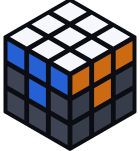
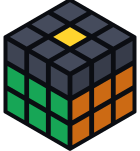
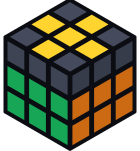
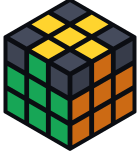
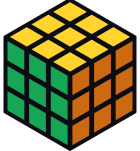
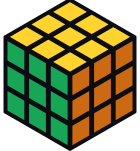
How to hold the cube
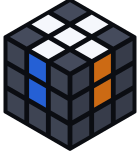
For step 1 you can hold the cube however you like. From step 2 onwards, keep white on the bottom and yellow on top. The algorithms in this guide assume that, and they always talk about the side facing you as the front.
Practise as you go
Reading is only half of it. Our cube trainer gives you a practice cube for each step, with the earlier steps already done, and checks your work. If you get lost on a real cube, put your colours into the solver to get back to solved, then try again.
Watch the most important move
R U R’ U’: you will use it in steps 2, 3 and 4.
How long will it take?
Your first solve might take half an hour with the guide open. After a week of practice most people can solve the cube in two or three minutes without looking anything up. With practice, the beginner’s method can get under a minute. To go much faster, speedcubers switch to a method called CFOP: see speedcubing basics.
Rubik's Cube is a trade mark of Spin Master. This site is not affiliated with or endorsed by Spin Master.
Questions people ask
What is the easiest way to solve a Rubik’s cube?
The layer-by-layer beginner’s method: white cross, white corners, middle layer, yellow cross, yellow edges, yellow corners in place, then twist the yellow corners. Each step uses one short move pattern.
How many moves does the beginner’s method take?
Usually somewhere between 100 and 180 turns. Speedcubing methods use about 55 to 60, and a computer can do any position in 20 or fewer.
Do I need to memorise lots of algorithms?
No. The beginner’s method uses seven short ones, and several of them are built from the same R U R’ U’ pattern.
Why do I keep messing up the layers I already solved?
It is usually a slip in an algorithm, or holding the cube the wrong way up. Keep white on the bottom from step 2 and do the moves slowly at first.
Can a child learn this?
Yes. Plenty of children solve the cube with this method, some from about age 7. See our tips for kids.