Step 1: How to Make the White Cross
Make a white cross on the bottom, with each white edge also matching the centre colour on its side. This is the first step of the beginner’s method and the only one without a set algorithm. It gets easier fast once you know the trick below.

What you are aiming for
The white cross is made of the white centre plus the four edges that have white on them (white-green, white-red, white-blue and white-orange). Edges are the pieces with two colours. A finished cross has all four white stickers on the white face and each edge’s other colour lined up with the centre on that side. A cross where the sides don’t match is not finished yet.
The daisy method (easiest way)
- Hold the cube with yellow on top. The yellow centre is opposite the white one.
- Make a daisy. Bring the four white edges up around the yellow centre, white stickers facing up. Think of four white petals round a yellow middle. If a spot you need is taken, turn the top (U) to move the white edge already there out of the way, then bring the next one up.
- Match and drop. Look at one petal and the colour on its side. Turn the top until that colour sits above its matching centre (red above red, for example). Then turn that face twice (F2, R2, L2 or B2) to send the edge down to the bottom. Its white sticker ends up on the white face.
- Repeat for the other three petals. Now the cross is on the bottom, ready for step 2.
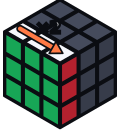
Watch it
Here the white-green edge is on top, already above the green centre. F2 sends it down into the cross.
Getting edges out of awkward places
- White edge in the middle layer: turn the face it is on, or the face beside it, a quarter turn so it rises to the top. Check you don’t knock out a petal already in the daisy (turn the top first if you need to).
- White edge on the bottom, white facing sideways: turn that side once to bring it into the middle layer, then up.
- White edge in the top, white facing sideways: turn that side so it goes into the middle layer, then up again the right way round.
Once you are comfortable, try building the cross straight on the bottom without the daisy. It takes fewer moves, and good speedcubers can always do it in eight moves or fewer.
Practise step 1 in the trainer
Tip: Centres never move compared with each other, so the green centre always tells you where green belongs.
Questions people ask
Why must the cross edges match the side centres?
Because the centres show where each colour belongs. A cross that doesn’t match will have to be fixed later, which breaks the corners you put in.
How many moves should the white cross take?
With the daisy, about 12 to 20. Done directly on the bottom, any cross can be made in 8 moves or fewer.